Mars has always held a special place in my imagination — its deep red glow in the night sky, the scars of ancient rivers carved across its surface, and the very real dream that one day humans might walk there.
As someone who is simply fascinated by space and the mysteries of the Red Planet, I’ve loved seeing the stunning discoveries we’ve made, even as online conspiracy theories seem to multiply just as fast.
There’s something about that dusty horizon that makes us want to believe in Martians and hidden cities. But as I've spent more time digging into the actual data from NASA, the ESA, and independent planetary scientists, I’ve realized that the reality of Mars is actually far more "out of this world" than the myths.
So let’s walk through the 10 most popular Mars conspiracy theories together, story by story, with the clear, evidence-based explanations that modern science actually provides.
Top 10 Mars Conspiracy Theories Debunked: Facts vs. Fiction
Over the years, I’ve come across dozens of intriguing — and sometimes wildly imaginative — Mars conspiracy theories. After carefully reviewing the actual scientific data and high-resolution imagery from ongoing missions, I’ve put together this list of the ten most popular ones, clearly separating fact from fiction with the latest evidence available as of April 2026.
1. The Famous “Face on Mars” and Ancient Alien Ruins

I still remember the thrill when the 1976 Viking 1 photo first appeared — a shadowy hill in the Cydonia region that looked unmistakably like a giant human face staring back at us. For many, it was instant proof of an ancient Martian civilization and alien ruins.
Yet when the Mars Global Surveyor returned razor-sharp images in 2001, and subsequent missions like the Mars Reconnaissance Orbiter provided even clearer views, the “face” transformed into exactly what it is: a perfectly ordinary mesa shaped by millions of years of wind and erosion.
This is classic pareidolia — our brains’ evolutionary hard-wiring to find familiar faces in random patterns. It's the same reason we see bunnies in clouds or faces on the Moon. You can examine the original low-res Viking image side-by-side with the high-resolution truth on NASA’s Mars Exploration site.
2. Mars Once Had an Advanced Civilization NASA Destroyed

The theory goes that a sophisticated civilization once flourished on Mars — until NASA or other agencies wiped out or hid every trace of it. Some even suggest a nuclear conflict ended the Martian "golden age."
In truth, Mars really was warmer and wetter billions of years ago with rivers, lakes, and possibly even oceans. But the planet lost its atmosphere after its internal dynamo died and its magnetic field faded, a process NASA’s MAVEN mission has mapped in exquisite detail.
Solar winds essentially stripped the air away over eons. After decades of orbital surveys and rover explorations, no evidence of any intelligent civilization — no bricks, no glass, no alloys, no structures — has ever surfaced. The geological record tells a story of natural planetary evolution, not destruction by any agency.
3. NASA Is Hiding Evidence of Life on Mars
Many believe NASA has already found microbial fossils or living organisms in rover photos but is keeping the discovery secret, pointing to oddly shaped rocks as “proof.”
Here’s the real story: NASA is actively hunting for ancient life and doing it in full public view. While many "fossils" in photos turn out to be ventifacts (rocks shaped by wind), the Perseverance rover has confirmed the presence of organic molecules in the Jezero Crater.
Recent findings from rocks like those in the Bright Angel formation (including the intriguing “Cheyava Falls” and “Sapphire Canyon” sample) even show textures, mineral associations such as iron phosphates and sulfides with organic carbon, and potential biosignatures that could hint at ancient chemical processes linked to microbial activity.
Scientists emphasize these are not yet confirmed as definitive signs of life and require further study, including sample return to Earth. This isn't hidden life itself, but exciting building blocks and clues. If NASA found definitive life, it would be the greatest discovery in human history; they have every reason to share it to secure future funding and inspire the world! Follow the mission’s daily progress and see the raw data yourself on the Perseverance Rover – NASA page.
4. Secret Human Colonies Already Exist on Mars

From "Project Camelot" to "Mars Defense Force," some claim governments or SpaceX already maintain hidden bases and thriving colonies on the Red Planet, utilizing secret "stargate" technology.
The reality is straightforward and far more exciting: no human has ever landed on Mars. The challenges of deadly cosmic radiation, razor-thin air (less than 1% of Earth's pressure), extreme temperatures, and self-sustaining life support are enormous hurdles we are only just now solving through open research.
Every plan, every technical failure, and every successful launch is discussed openly in the scientific community and international space agencies. See the latest international roadmap on ESA’s Mars Exploration page.
5. The Mars Rovers Are Filmed on Earth
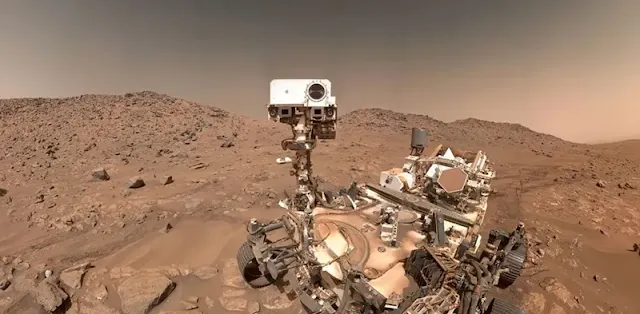
A surprisingly common claim is that all those dramatic rover photos and videos are actually shot in Earth deserts like Devon Island in Canada and then “painted” red to fool the public.
The proof that the rovers are truly on Mars is rock-solid. Orbiters from multiple countries — including China’s Tianwen-1 and India’s MOM — have photographed the exact landing sites and rover tracks from above. Furthermore, the 4- to 24-minute radio delay caused by the speed of light (c ≈ 3 × 10⁸ m/s) and independent amateur radio tracking confirm the enormous distance.
Explore the unprocessed raw images straight from the surface on NASA’s Raw Images archive.
6. Mars Has a Thicker, Breathable Atmosphere
Some insist NASA is hiding the truth: Mars actually has a thick, Earth-like atmosphere with blue skies, and we could breathe there without suits. They often point to photos where the sky looks blue as evidence.
The facts are clear. Mars’ atmosphere is roughly 100 times thinner than Earth’s and consists of about 95% carbon dioxide, with only trace amounts of oxygen. Those occasional blue skies in photos are usually either sunsets — where dust scattering actually creates a blue glow (the opposite of Earth!) — or "white-balanced" images.
Scientists adjust the color so rocks look like they would under Earth's sun, helping geologists identify minerals. Without a pressurized suit, a human would lose consciousness in seconds due to the lack of pressure and oxygen. The thin atmosphere is well-documented by multiple landers, orbiters, and MAVEN data.
7. Hidden Oceans Still Exist on Mars

Stories of vast underground oceans or hidden seas still flowing today refuse to fade, fueled by radar data that seems to show liquid layers deep beneath the ice.
Mars absolutely had real oceans billions of years ago. Today, most of that water is frozen at the poles or locked in the soil as ice. While some radar data from ESA’s Mars Express initially suggested possible briny liquid lakes under the southern ice cap, more recent studies (including high-frequency radar data from NASA's Mars Reconnaissance Orbiter) indicate these bright reflections are more likely explained by layers of frozen clay or other mineral deposits rather than liquid water.
The search for any "salty sludge" or subsurface habitability continues with ongoing analysis, but current evidence points to mostly frozen remnants. If you're curious about the many remaining questions surrounding Mars' watery past and present, I highly recommend reading my companion piece: 10 Unsolved Mysteries of Mars.
8. The Mysterious Rectangular Monolith on Mars

This tall, rectangular boulder spotted in high-resolution images looks eerily man-made — like something out of 2001: A Space Odyssey. It’s a favorite in conspiracy circles as an alien "artifact."
Planetary scientists explain it as a perfectly natural rock slab. On Mars, rocks often fracture along straight, geometric joints due to stress and cooling, especially when tumbling down cliffs.
Wind erosion then polishes the edges, creating "monoliths" that look intentional but are purely geological. We see similar rectangular formations here on Earth, such as basalt columns at the Giant's Causeway in Ireland. The image comes from NASA’s Mars Reconnaissance Orbiter HiRISE camera, and the full dataset is public for any amateur geologist to study.
9. Elon Musk Knows Secret Information About Mars
A recurring theory claims Elon Musk has access to classified knowledge — perhaps from recovered alien tech — that gives SpaceX an inside track on Mars colonization. Some think his "Starship" is based on Martian designs.
The reality is refreshingly transparent: every aspect of SpaceX’s Mars vision builds on decades of open-source NASA and ESA research, combined with innovative engineering. Musk’s "secret" is rapid iteration, reusable rocket technology, and massive private funding, not hidden alien secrets.
The technical challenges, like the Raptor engine physics and heat shield chemistry, are shared in public patents, technical papers, and live presentations. You can read the current vision straight from the source on the SpaceX Mars page.
10. The “Mars Hum” and Underground Alien Bases
When NASA’s InSight lander picked up a faint, low humming sound, some immediately claimed it was evidence of underground machinery or secret alien bases operating beneath the crust.
The actual explanation is a geologist's dream: the hum comes from natural seismic vibrations and atmospheric interactions. Mars doesn't have tectonic plates like Earth, so it "rings" differently as the crust cools and contracts, creating Marsquakes.
What some called "machinery" was actually the sound of the planet's internal heat escaping combined with wind and other natural processes. All of InSight’s data is publicly archived, so anyone can listen to the pulse of a cooling planet on the NASA InSight page.
Conclusion: The Real Mars is Better Than Fiction
After walking through these ten theories, one thing stands out to me: the real story of Mars is already more astonishing than any conspiracy. We are looking at a world that was once an Earth-twin, now a frozen desert waiting for its first human footsteps.
Ancient rivers that once carved deep valleys, water still hiding in the dust (perhaps as ice or brines), organic molecules, and intriguing chemical clues that keep scientists excited about the possibility of ancient microbial life. The very real possibility that we might see a "Mars Landing" on our TVs in the coming decades makes it all the more thrilling.
Every new photo, seismic rumble, and rover discovery brings us closer to the truth. While the "Face on Mars" was just a trick of the light, the search for actual signs of past habitability on the Red Planet is the real adventure of our century — and it's happening in the open for all of us to follow.
Which Mars theory surprised you the most, or which one still makes you wonder? Drop your thoughts in the comments — I read every one and love discussing these cosmic mysteries with fellow space enthusiasts.
Read More:
All information based on official NASA, ESA, and peer-reviewed scientific data verified as of April 2026. Written with genuine curiosity to bridge the gap between speculative wonder and evidence-based science. Sources include mission websites, published papers, and public archives for full transparency and verifiability.


No comments:
Post a Comment